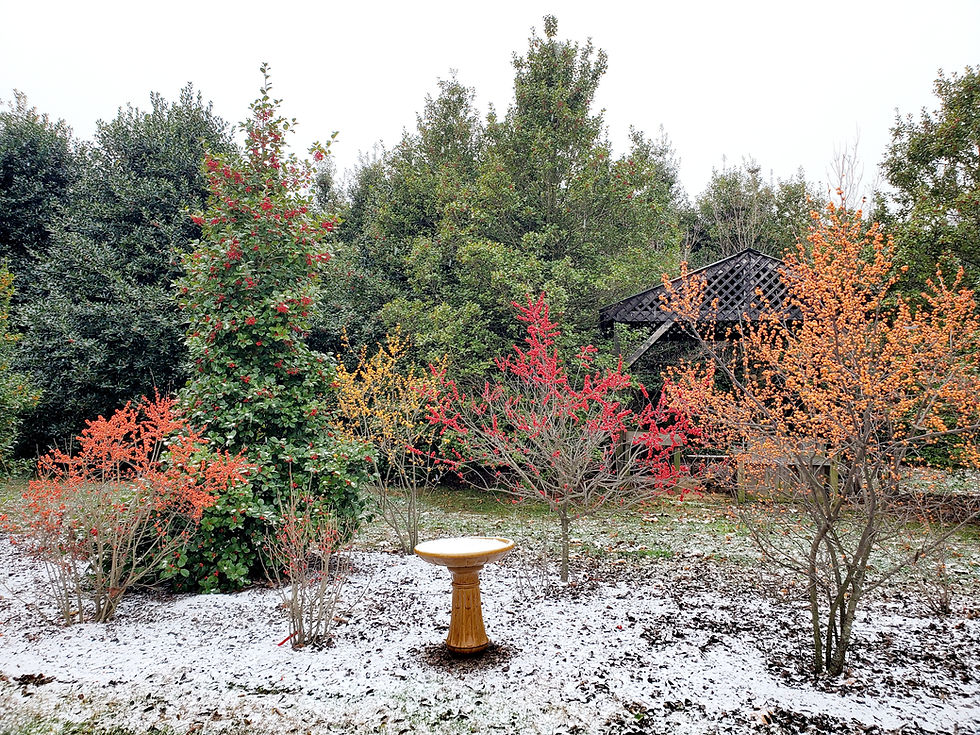
Heartwood Nursery American Holly ‘Sundown’ Is Named 2026 Holly of the Year
Updated: Jan 24
Sue Hunter, Owner, Heartwood Nursery
I'm honored to share that one of my best Hollies, the native American Holly Ilex opaca 'Sundown', has been chosen as the 2026 Holly of the Year by the Holly Society of America Research & Development & Test Holly Program and Holly of the Year Committee.
Meeting the criteria for this distinguished designation requires years of research and dedicated observation. Most of us have heard the old saying “Oaks from little acorns grow.” But have you ever witnessed the growth progression of a Holly tree from a tiny seed?

Ninety-five percent of American Holly trees that start out in the wild were deposited as seed in the soil by birds roosting in the trees in the fall through winter. The young Holly seedlings often go unnoticed until they’re a few years old and displaying their evergreen foliage among the bare deciduous woods during the winter. As a lifelong Holly selector and grower, I look with a keen eye for outstanding characteristics of every Holly seedling I see, as no two are exactly alike. These characteristics include:
Leaf size
Leaf color
Growth habit
Branching habit
Berry size
Berry shape
Berry color
Overall plant vigor
Fifteen years ago, I happened upon the American Holly seedling I would later name 'Sundown' when I was walking the edge of my woods here at Heartwood. I knew right away this Holly was special: Even at a few feet tall, she already had exceptionally met the above-listed criteria.
As Hollies move into summer dormancy around the end of July through August, I decided to move Sundown one day in late summer when she was about 12 feet tall. The timing was perfect for transplanting Hollies. The days were 90 degrees, humid, and we’d just had a soaking rain two days prior. So perfect were the conditions that I tagged seven Holly seedlings that day, each displaying different characteristics, and had them moved closer to the greenhouses, where I could observe them daily.
The Hollies we moved received supplemental water until the rainfall caught up for this area. After that, they were not pruned, shaped, or modified in any way. It's always preferable to let Hollies develop on their own.
We began taking cuttings of 'Sundown' one year after transplanting. She was continuing to show outstanding aesthetics:
Larger than normal leaf
Darker green than normal leaf
Strong terminal leader
Evenly distributed and equal branching habit
Bright red consistent berry-set
Minimal spring shedding of older leaves
In addition, the cuttings proved easy to root and grow on into larger containers. These are all qualities growers want to see in a Holly of the Year.
That was just the beginning! Our next steps included registering the Holly selection through the Holly Society of America, who is recognized as the Official Registrar for the genus Ilex by the Royal Horticultural Society International Registrar.
We consistently took countless photos of the new selection throughout the year in all seasons, to give growers and retail customers a chance to envision 'Sundown' in their landscape or garden.

We also take trays of rooted starter plants to horticulture trade shows every year to enable industry professionals to ask questions, scrutinize the rooted cuttings, and determine when to fit rooted cuttings into their growing schedules.
There are many American Holly selections, and occasionally people ask me why there are so many. The answer is, because no other Genus has the genetic diversification exhibited.
Holly growers love Hollies. We want to share these remarkable plants with our customers. When taking cuttings of a selection such as 'Sundown', I'm sharing with you a vigorous, healthy, bird-loving, long-lived, native American evergreen that I call the Crown Jewel of the Horticulture World.
Every time birds eat a berry from an outstanding, naturally occurring Holly selection, the seeds that grow from those deposited berries are NOT clones, but rather carry the genetic diversity being passed down through naturally occurring pollination!
Want to learn more about Heartwood Hollies? Visit our Holly propagation and Holly Arboretum pages and see our Holly list. And give me a call at (717) 993-5230.